Angelique Jiménez

“WAIT” has become one of the most prominent words of our day and age. Our culture hangs on to the old axiom, “Good things come to those who wait,” as if our life depends on it. It’s true, waiting can, and does, produce good things, but only if the waiting has a definite ending point. Waiting and action are two sides of the same coin. One ceases to lose its efficacy, as well as its worth, when the other is left out. A similar example could be given about “yes” and “no.” Our yes means nothing when we cannot say no; our no means nothing when we cannot say yes. The same applies to waiting and action: both are necessary in order for the other to be effective. They go hand-in-hand.
One of the conversations I end up in the most with others is the “to be or not to be” conversation. Interestingly, if you search on Google for the meaning of Hamlet’s most famous phrase, the summary you are given is that it highlights “the struggle between action and inaction in the face of despair.” As stark as that seems, I find it an apt description. While not everyone is in despair, many certainly lack hope, and a lack of hope fuels fear. This is why inaction has become so popular: It has become a word synomonous with “safety,” and it seeks to supplant fear with a certainty that “nothing unpredictable will happen.” Inaction, when chosen incorrectly, feigns bravery, disguises itself as wordly wisdom, and ultimately leaves us stuck.
For many, this idea of waiting for ideal conditions before making a move has bled into their discernment. They forget that the “waiting and listening” part of discernment is only the first half of it – the second half is definitively choosing an action based on what they’ve received during the first half. I say received rather than based on what they’ve discerned, because such language, again, implies that discernment relates only to passivity, and that any action made after it is a separate endeavor instead of part of the same process. Another way to think of discernment is to consider that the first half of it requires receiving and the second half requires responding (A.K.A., giving.) After all, the point of discernment, for the Christian, is to discover the ways God is calling one into deeper relationship with Him. Relationship requires both receiving love and giving it. Relationship (with God) is what lies at the heart of discernment, and that realization changes how discernment is approached.
In the world, no area has been as affected by what I am now calling “The Waiting Game” as dating and marriage. And it’s a game most people are losing. The misunderstandings surrounding the nature of proper discernment has not helped. I understand the viewpoint of those who are afraid of making a mistake or being hurt. I’ve also fallen victim to the “I should wait until everything is perfect” mentality. However, I think one of the greatest lessons I am learning in my own marriage is that the real way to win the world’s “Waiting Game” is, quite simply, to stop waiting. What I usually share with those people who are struggling to move forward is what God did for me when I let go of my ideas of what perfect looked like in dating and marriage.
When Leo and I became friends, we were hardly ideal marriage candidates by worldy standards. At the time, I was studying for a GED, Leo was working in retail, and both of us lived with our families respectitively. Two months after becoming acquainted, Leo asked me out. Three months after that, we made the unpopular decision to get engaged “so soon.” We had no idea how we would afford a place to live or starting a family. Even so, we knew God was leading us in that direction and He said to keep going, so we did. The pandemic hit in the midst of all this, but we kept doing what we could. It’s better to move forward slowly than not at all.
God allowed things to be cut close, but He grew our trust at the same time. Only three months before the wedding, I was offered my first, full time job. Two months before the wedding, Leo found a full time job. One month before the wedding, we found an apartment we could afford to rent.
Despite COVID, we got married, giving up any reception or party afterwards, as well as an overseas honeymoon. We wanted to become full helpmates to each other, and we knew we could always celebrate with family and friends and take the overseas trip later. We honeymooned more locally instead. I got pregnant right after we got married, and got accepted into university not long after. I had to put off university until after the birth, but the university was incredibly supportive of the fact that we were starting a family, and they told me to contact them when I was ready to start.
In my last trimester of pregnancy, I had to rush Leo to the ER because of overwork due to the circumstances in his job. Two weeks after I gave birth, while I was recovering on our couch from my c-section, we realized that Leo needed to quit his job and look for a new one for the sake of his health. I was on maternity leave, and we were very aware that my job wouldn’t be enough to support all of us when we made the decision, but Leo’s health was more important. Only two weeks after he quit his job, he was offered a job in the field of work he had been hoping for. He still gratefully works in that field today.
Leo and I don’t believe in coincidences, but we do believe in God’s Providence, and we’ve experienced it firsthand. Did we struggle greatly our first few years of marriage? Absolutely. We often didn’t know where the money, the job, the energy, or a gazillion other things we needed was going to come from. Leo worked a job that wasn’t his favorite for a year just to pay our bills. I did the same for 4 years before getting a job in the field I wanted. We lived with less than others we knew had. But we always had enough.
We didn’t simply sit around and blindly wait for God to fix things. Rather, God taught us that He works in both passivity and action. God gave us reason, and He expected us to use it. We still had to play our part. I still had to get the GED and apply for college. We still had to apply for jobs. We still had to search for a place to live, and we moved three times in under five years before finally settling where we live now. However, in the midst of everything, our practical life became an extension of our interior one – a life of the constant receiving of God’s love and of choosing to return it to the best of our ability (which often was done very poorly.) What God did was to use each of us as an impetus for the other. As single people, we had moved forward as far as we could on our own. As a couple, we were able to overcome practical and spiritual barriers we couldn’t previously. Receiving, acting, receiving, acting; receive, respond, receive, respond – that was the daily rhythm of our life. It’s an ongoing process we are still in today.
Our life still isn’t perfect. We still don’t have everything “figured out,” but the life we’re building, our two daughters, our current jobs, our current community – none of them would have happened if we hadn’t chosen to follow God and risk everything: if Leo hadn’t chosen to ask me out, and I hadn’t chosen to say yes (and the same again when he asked me to marry him.) And all the things we had to give up to keep our relationship moving forward.
My advice to those single people who are scared of moving forward in dating and/or marriage is this: Don’t be. It’s not all up to you. Do what you can, which will be very imperfect, and trust God. It won’t always be easy, but if it’s what God is asking of you, it will be possible. He will make it possible. God will replace the buzzwords of “perfect timing,” “easy,” and “having it all together” with new words: “possible,” “hope,” and a “perfectly imperfect life” because without realizing it, you will have started living a life which enables you to love to the fullest, both in your relationship with God and in your relationship with your significant other. And both lead to an awe-inspiring present and future.
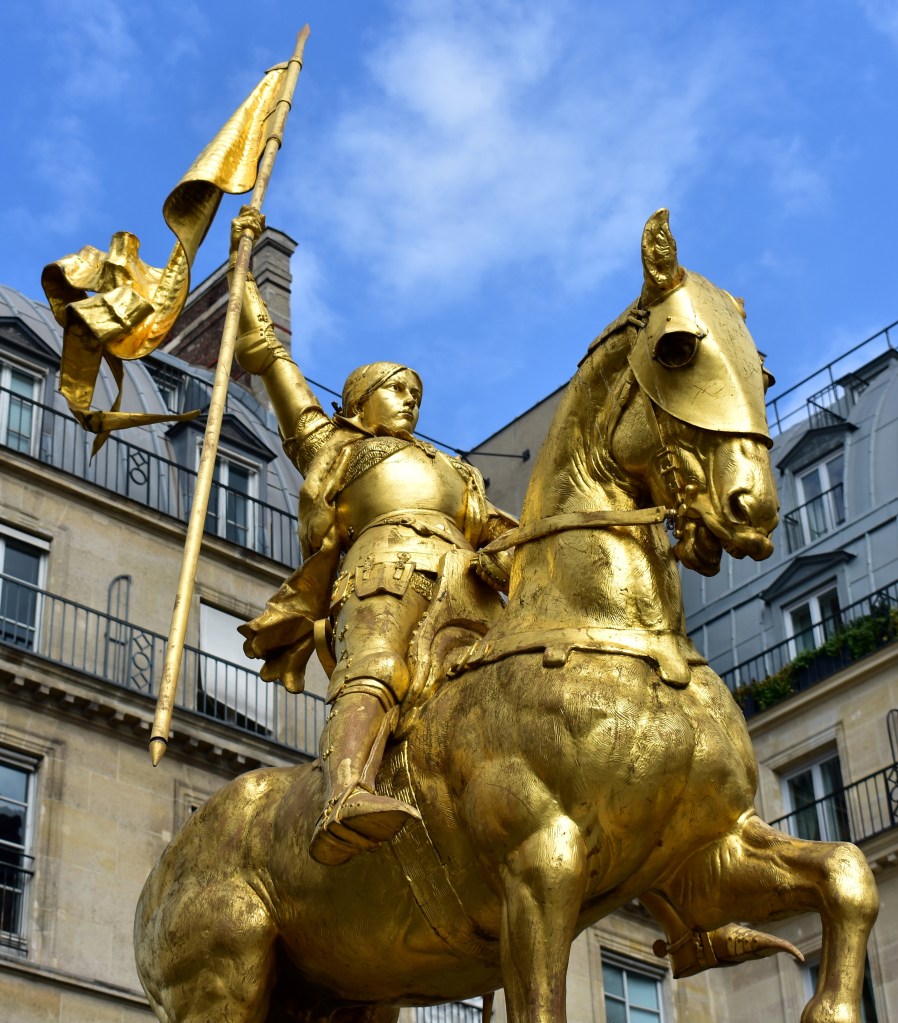
To end, here is a note from a saint known for her courage – St. Joan of Arc – whose feast day was at the end of May. As we continue to leave last month behind and to dive into June, let us take her own words that were declared in the May of 1429 with us into this new month, and into the rest of our lives:
“In God’s name! Let us go on bravely!” `
St. Joan of Arc


Leave a Reply